
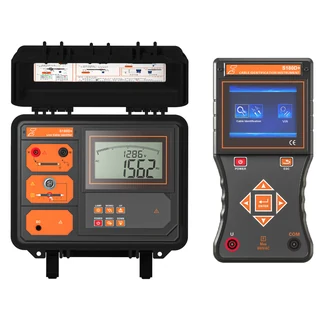
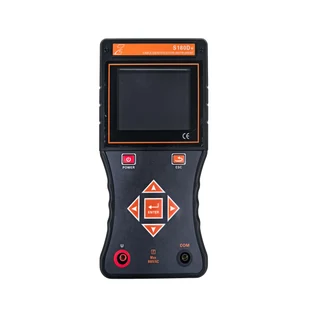
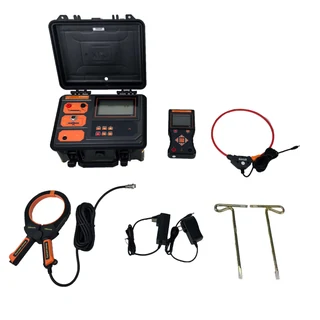
S180D+ Cable Identifier

  • Clamp-coupled identification of suitable live 3-core armoured cables

  • Direct-connection identification of de-energized cables

  • Selectable signal frequencies for different cable-identification conditions

  • Near-end calibration with comparison of signal magnitude and direction

  • Stores up to 10 calibration references

  • 200 mm flexible receiving coil and 105 mm transmitting clamp

  • 3.5-inch colour TFT receiver with selectable signal gain

  • Rechargeable battery operation for transmitter and receiver

Product Description

The S180D+ is a cable identifier for identifying a target within a group of energized or de-energized cables. It applies a signal by clamp coupling to suitable energized three-core armoured cables and by direct connection for dead cable identification. The receiving coil compares signal magnitude and direction against a reference established at a known near-end location.

Selectable frequencies and receiver gain help match the identification method to the cable and grounding conditions. Up to 10 stored calibration references support repeated comparisons, while the colour display shows the identification result and signal information. The transmitter and handheld receiver operate from rechargeable batteries; an optional detector provides an alternative sensor for suitable applications.

Technical FAQ

How does the S180D+ identify live and dead cables?
Live cable identification uses the transmitting clamp on suitable three-core armoured cables, with suitable grounding at both ends of the sheath. The manual excludes ultra-high-voltage single-core operating cables from this method. Dead cable identification uses direct connection to the isolated cable. These are separate operating methods: the direct output leads must not be connected to a live power cable.
Why is near-end calibration required?
The receiver records the target signal current and direction at a known location as the comparison reference. During identification, the signal magnitude is compared with the calibrated value and the indicated direction is checked. Frequency and gain must remain consistent with the stored reference; if either is changed, the reference must be calibrated again.
Which identification frequencies are available?
For energized cable identification, the transmitter provides 625 Hz, 1562 Hz, 2500 Hz and 10000 Hz. For de-energized cable identification, it provides 1562 Hz and 2500 Hz. The manual describes 10000 Hz as a special method requiring manual interpretation: its indication is a reference rather than the final identification result.
What sensors are available?
The system uses a 105 mm transmitting clamp and a flexible receiving coil with a nominal 200 mm inner diameter. An optional detector is documented for applications where the receiving coil is inconvenient to fit. The same selected receiver sensor should be used for self-checking, calibration and the subsequent identification procedure.