


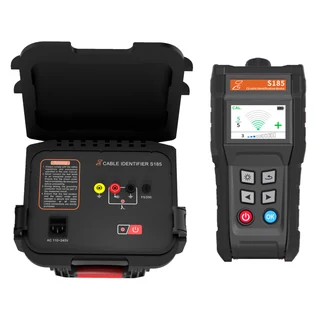
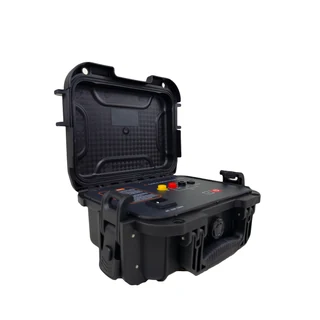
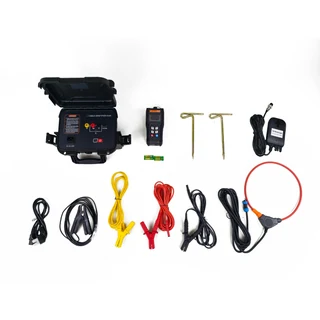
S185 DE-Energized Cable Identifier
- De-energized cable identification with direct DC pulse injection
- Transmitter output up to 120 A, with 72 V pulse voltage
- Polarity and amplitude comparison against a stored near-end reference
- Calibration locks receiver gain for consistent on-site comparison
- 200 mm receiving coil
- Stethoscope mode for compatible twisted-conductor applications
- 2.19-inch colour receiver display with 10 gain levels
Product Description
The S185 is a de-energized cable identifier for selecting the correct cable within grouped underground or overhead installations. Its battery-powered transmitter injects DC pulses through a directly connected, isolated cable. The handheld receiver checks pulse direction and amplitude against a reference established at the near end.
The flexible receiving coil and colour display support comparisons in cable trenches, switchgear rooms and industrial installations. Once calibrated, the receiver gain remains fixed so the stored reference can be used at the identification point. Stethoscope mode provides a further method for compatible twisted-conductor cables where the standard receiving coil cannot be applied.
Technical FAQ
Can the S185 identify an energized cable?
No. The S185 is designed for positive identification of de-energized and safely isolated cables. Before connecting the transmitter, confirm that the target cable has been disconnected from all power sources, tested for absence of voltage and grounded in accordance with the applicable safety procedure. For energized cable identification, use an instrument specifically designed and rated for live-cable operation.
Why is the received S185 signal weak?
A weak signal is normally caused by excessive loop resistance, poor grounding, loose connections or an unsuitable transmitter connection. Check that the remote end is correctly grounded, clean all connection points and confirm that the cable forms a complete return path. Increasing receiver gain may make the signal easier to detect, but the strongest identification is achieved by improving the transmitted current rather than relying only on higher gain.
How is the receiver calibrated?
At a known near-end section of the target cable, point the receiving-coil arrow toward the far end. Adjust gain to obtain a stable green response, normally 7–8 amplitude bars, then store the reference. Gain is locked after calibration. Keep the coil direction consistent and compare every cable at the identification location to establish a unique target.
When should Stethoscope Mode be used?
The manual describes Stethoscope Mode for compatible twisted-conductor cables where the normal identification coil cannot be applied or a defined return path is unavailable. The probe is moved along or around the cable to compare the magnetic-field pattern. It is not a general method for every cable type; untwisted or unsupported cable constructions can give misleading indications.