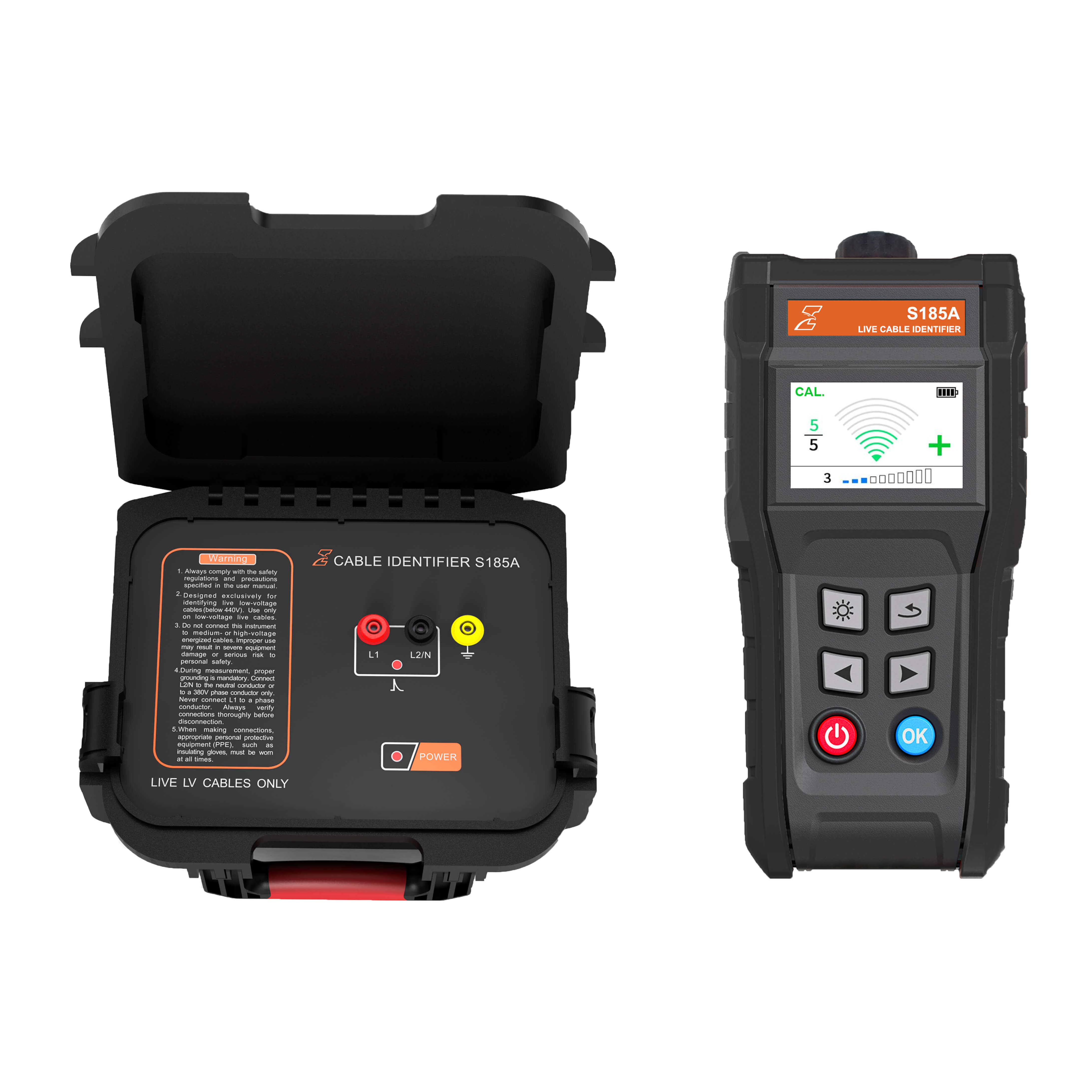
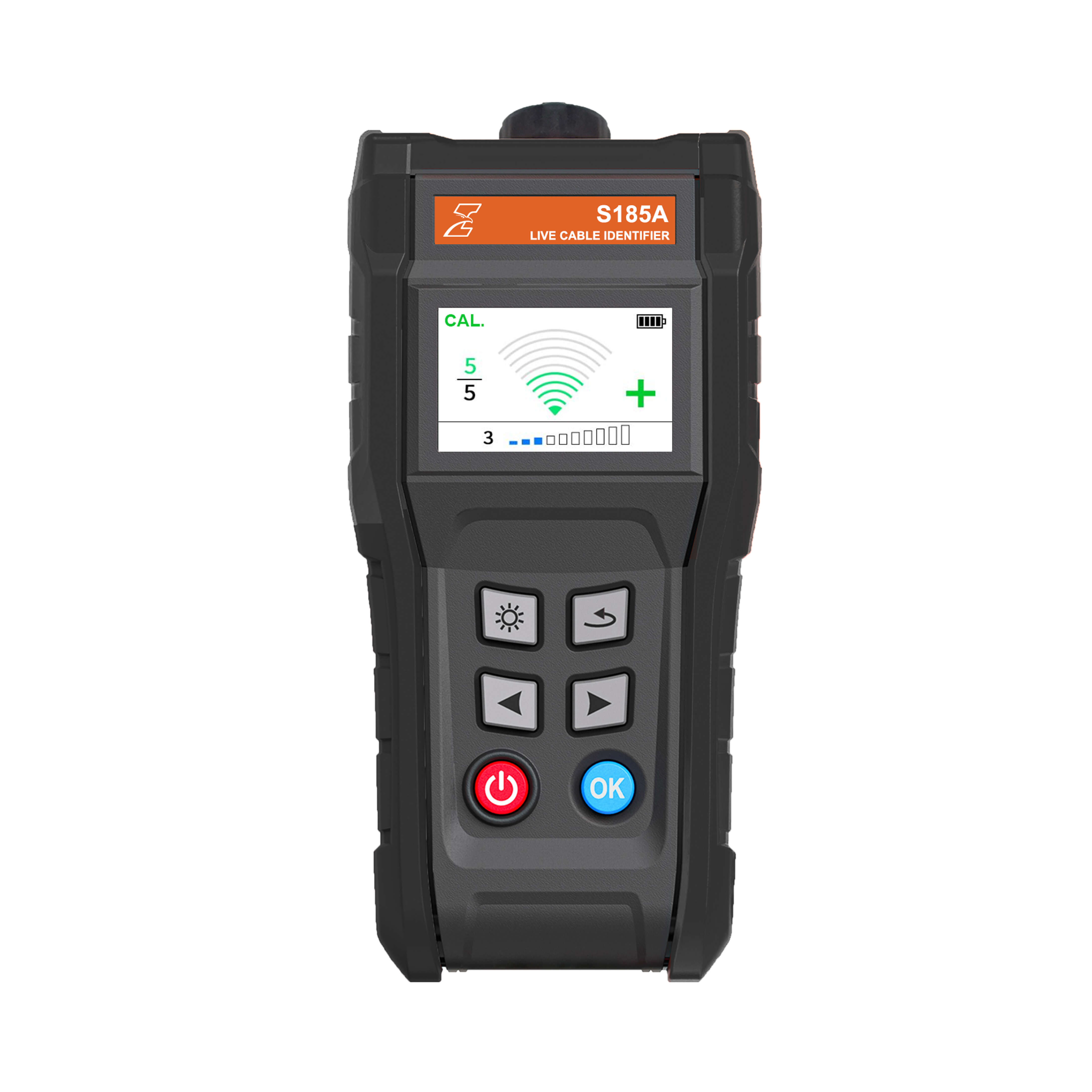
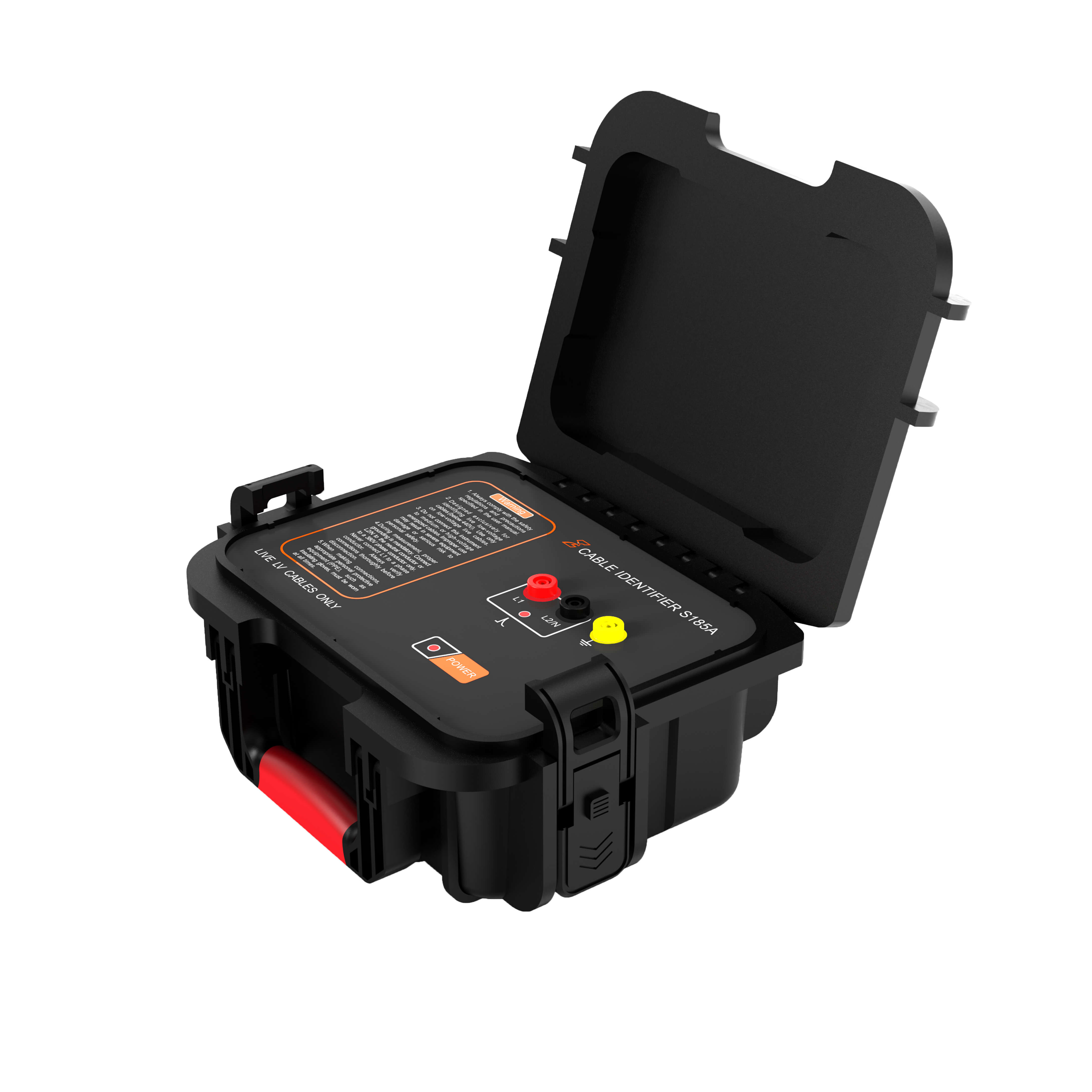
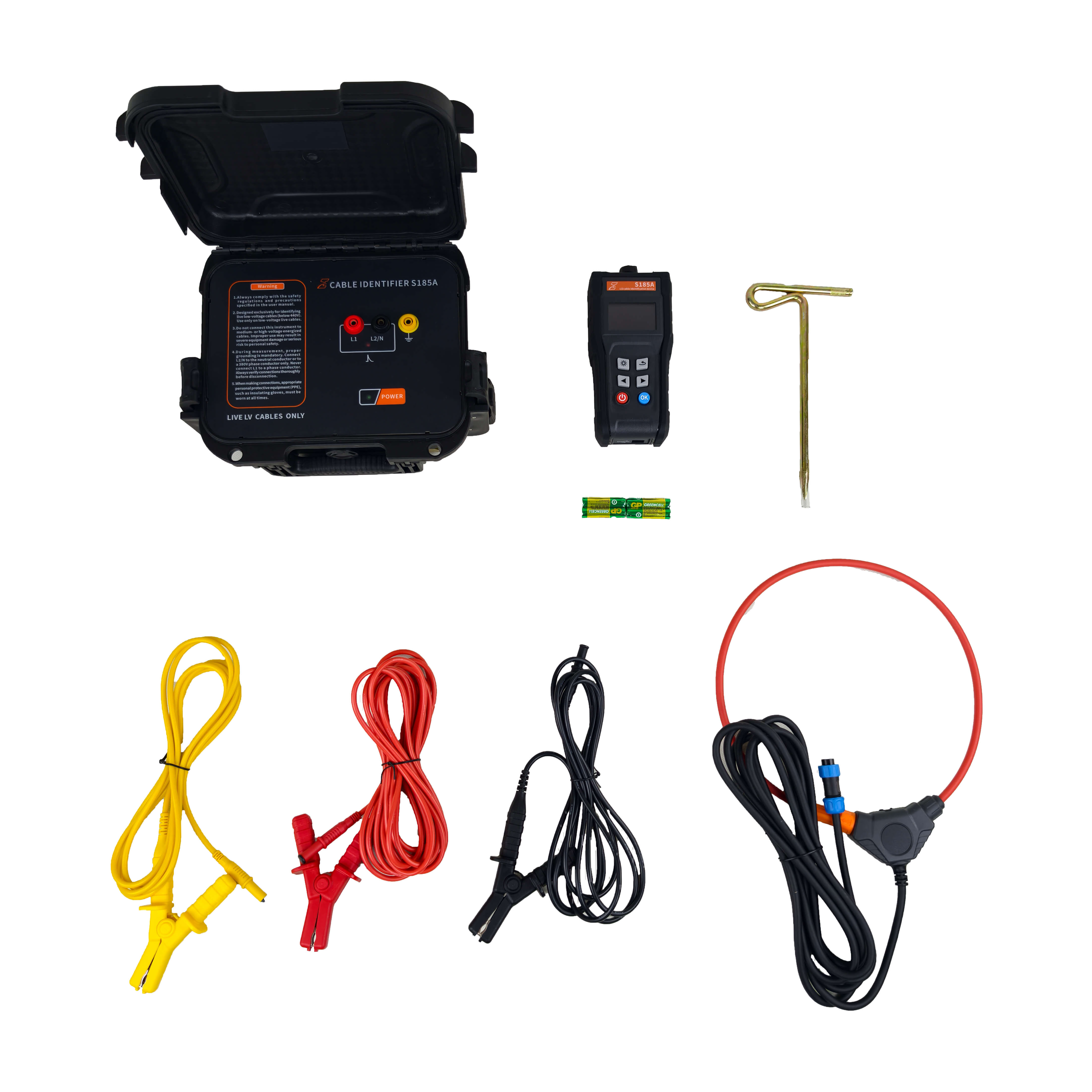

S185A Live Cable Identifier

  • Live LV cable identification (Rated up to 440 V AC systems)

  • Discrimination logic: Pulse polarity vector (+/-) and calibrated amplitude dual check

  • Power supply: 110 V ~ 440 V AC direct parasitic line powering (No external battery/mains)

  • Transmitter pulse output: 85 A ± 10 A DC pulse, 1.7 ms pulse width, 30 pulses/min

  • Standard sensor: Φ200 mm flexible Rogowski coil (Optional Φ100 mm / Φ300 mm)

  • Auxiliary sensor: Magnetic stethoscope probe (For conduit & twisted conductors)

  • Display & tuning: 2.19-inch color LCD, 10-step gain adjustment

  • Weight: Receiver 0.33 kg, Transmitter 1.78 kg

  • Ingress & safety: IP54 rating, compliant with IEC 61010-1


Product Description

Accurate identification of specific low-voltage cables in multi-cable distribution trenches, switchrooms, and transformer substations is essential prior to jointing, tapping, or cutting work. Accidental incision of adjacent energized cables presents severe arc-flash hazards, extensive customer outages, and personnel risk. The live cable identifier injects pulsed test signals into the target circuit and analyzes current direction alongside calibrated amplitude to assist operators in verifying cable identity during online testing, substantially reducing the risk of unnecessary service interruptions.

  • Applicable Cables & Typical Sites: Designed for energized low-voltage cable identification on power systems up to 440 V AC. Typical applications include LV switchboards and distribution panels, transformer LV outgoing feeders, underground cable trenches, utility rooms, industrial facilities, and urban distribution networks. The flexible Rogowski coil supports large-diameter cables and installations with limited access. For twisted multi-core cables or special return-path conditions, the optional Stethoscope Mode provides an additional identification method where applicable.

  • Core Measurement Parameters: The transmitter injects an intermittent DC pulse current of 85 A ± 10 A with a 1.7 ms pulse width at a repetition rate of 30 pulses/minute (1 pulse every 2 seconds). The receiver provides 10-step gain tuning and couples via an inner diameter 200 mm flexible Rogowski coil (with optional 100 mm and 300 mm versions).

  • Technical Features & On-Site Protection: Equipped with direct parasitic line powering (110 V to 440 V AC), operating without external generators or auxiliary battery packs. The 1.7 ms micro-pulse energy typically remains below upstream breaker time-current trip curves under standard operating conditions, helping prevent unintended tripping. Dual verification of current vector polarity (green "+" / red "-") and calibrated amplitude substantially suppresses false indications caused by inductive return currents in adjacent parallel feeders. For tight conduits or twisted cables, auxiliary magnetic Stethoscope mode detects cyclical lay-pitch variations along the cable axis. The system complies with IEC 61010 standards with an IP54 ingress protection rating.


Technical FAQ
Can the cable identifier test energized cables, or does it only work on de-energized circuits?
The live cable identifier is engineered specifically for direct-connection operation on energized low-voltage distribution networks rated up to 440 V AC. It incorporates direct parasitic line powering (operating across 110 V to 440 V AC), allowing the transmitter to draw power directly from the live feeder under test without requiring external generators or separate charging packs. The transmitter injects an intermittent DC pulse of 85 A ± 10 A (pulse width 1.7 ms at 30 pulses/minute). Because the pulse duration is tightly controlled to 1.7 ms, the injected energy typically remains below standard upstream breaker trip curves under normal conditions, helping mitigate trip risks and supporting continuous maintenance procedures.
In multi-cable trenches, will adjacent parallel cables also carry signals, and does the instrument evaluate signal strength or direction?
In shared cable trenches, adjacent parallel lines often carry induced signals or common-ground return currents. Unlike conventional detectors that evaluate amplitude alone, the live cable identification system employs synchronized dual verification of pulse current polarity (direction) and calibrated amplitude. On the receiver's color LCD, the target cable displays an unambiguous green "+" icon alongside calibrated amplitude bars (recommended calibration to 7–8 bars). Adjacent cables carry current flowing in the reverse direction, displaying a red "-" icon or negligible amplitude. Operators clamp and test each cable in the bundle one by one to confirm target cable uniqueness, substantially reducing misidentification risks.
What cable diameter can the flexible current clamp accommodate, and how does it handle oversized cables or tight trench spaces?
The instrument is equipped with a standard flexible Rogowski coil with an inner diameter of 200 mm, effortlessly encircling large-diameter low-voltage distribution cables, single-phase runs, and dense cable bundles. For customized requirements, optional 100 mm and 300 mm coils are also supported. Compared with rigid and heavy traditional iron-core clamps, the flexible coil is lightweight, slim, and highly flexible, allowing operators to slide it easily through crowded cable trenches, conduit bends, and narrow switchgear cabinets where rigid jaws cannot close.
Why is strict adherence to the arrow direction on the current clamp required during testing?
The flexible Rogowski coil detects current vector orientation. When clamping the target cable, the arrow molded onto the sensor must point toward the far end of the cable. Correct arrow alignment ensures the injected pulse matches the receiver's calibrated polarity logic. If the clamp is reversed (arrow pointing back toward the transmitter), the true target cable will indicate an inverted red signal amplitude bar or a "-" icon, leading to operational confusion. Maintaining consistent arrow orientation is therefore fundamental to reliable polarity discrimination.
Can both single-core and multi-core cables be identified, especially when cables are twisted or enclosed in conduit?
Yes. For accessible single-core or multi-core cables where clear access is available, the standard 200 mm flexible Rogowski coil can encircle the cable directly. When physical clearances prevent looping a clamp (such as in tight conduits or multi-point bonded sheaths), or when testing multi-core twisted conductor cables, the system provides an auxiliary Stethoscope Mode. Operators place the magnetic stethoscope probe against the cable outer sheath and slide it longitudinally. Because the inner conductors are spirally twisted, the receiver detects cyclical signal fluctuations (alternating high and low amplitude) corresponding to the internal lay-pitch, enabling reliable confirmation without separating bundles or unsealing conduit.