
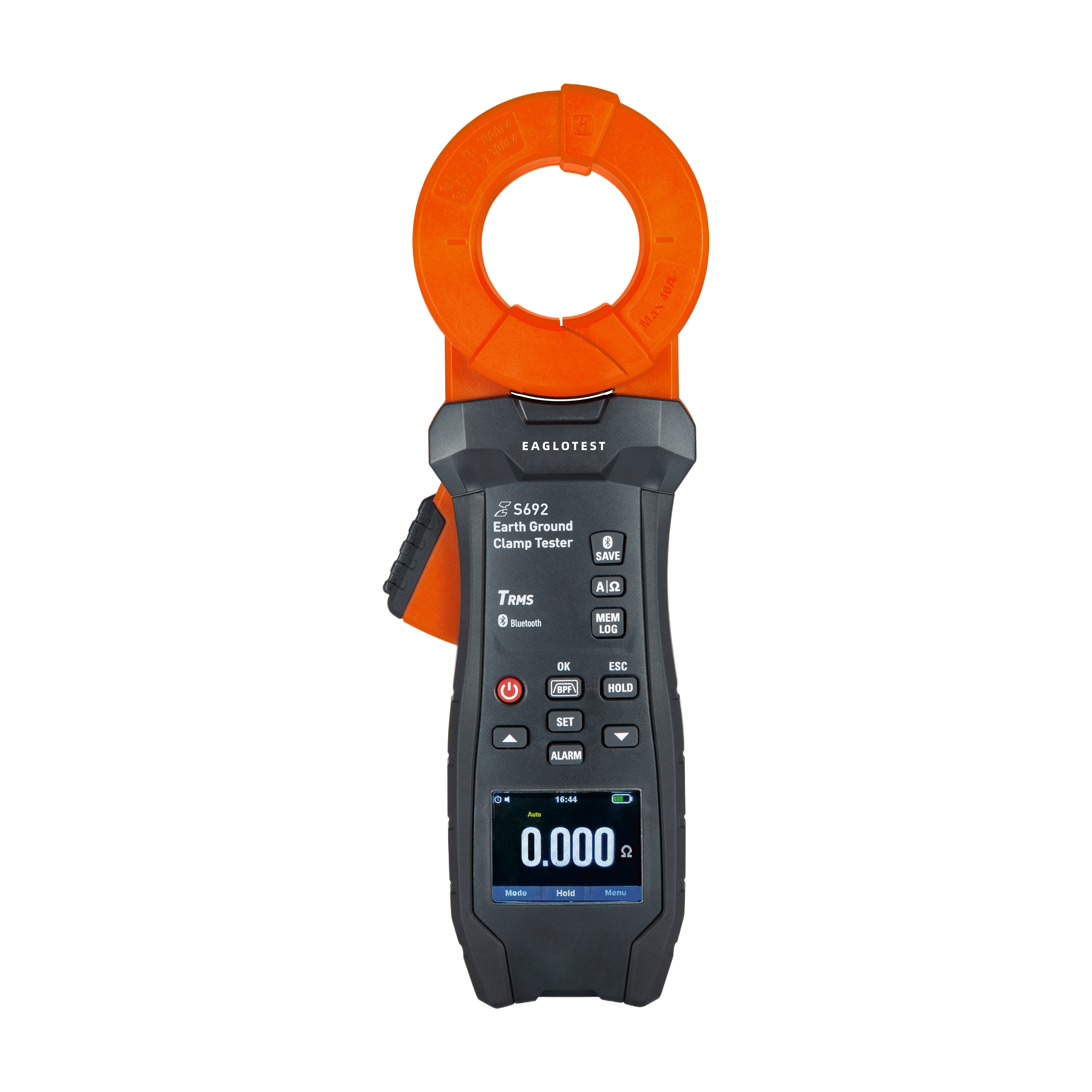
S692 Earth Ground Clamp Tester

  • Clamp-on Ground Resistance Measurement 0.025 Ω to 1500 Ω

  • AC Current Measurement up to 40A

  • 45mm Large Jaw Opening

  • 2000 Records Storage

  • IEC61010-1 / CAT III 1000V / CAT IV 600V Safety Rating


Product Description

The S692 Earth Ground Clamp / Earthing Clamp is a handheld instrument designed for measuring loop resistance and leakage current in electrical grounding setups. It eliminates traditional field issues such as disconnecting the grounding electrode or driving auxiliary stakes, measuring values in seconds to provide strong technical support for grounding system maintenance, leakage current testing, and safety diagnostics.

Technical FAQ
Can a clamp ground tester measure a completely isolated grounding electrode?
Normally, no. A clamp ground-resistance tester requires a closed conductive loop through the grounding system. The instrument induces a test signal into the loop and measures the resulting current. A single isolated rod with no parallel return path does not form a complete loop, so a valid clamp resistance measurement cannot be obtained. In that situation, use an appropriate fall-of-potential or other stake-based test method.
Why does the S692 show an unstable or unusually high resistance?
Check that the clamp jaws are completely closed and that the mating surfaces are clean. Dirt, corrosion, jaw misalignment or a conductor positioned incorrectly in the clamp can affect the magnetic circuit. The grounding system may also have intermittent connections or excessive electrical interference. Clean the jaws, clamp only one conductor, repeat the measurement and compare the result at a stable position on the conductor.
Can the S692 measure leakage current without disconnecting the grounding conductor?
Yes. Clamp-based current measurement allows current flowing in a grounding conductor to be checked without opening the conductor. Clamp around one conductor only and ensure the jaws are fully closed. The displayed current represents the net current passing through the clamp aperture. Clamping around both outgoing and returning conductors may cause the magnetic fields to cancel and produce an incorrect reading.